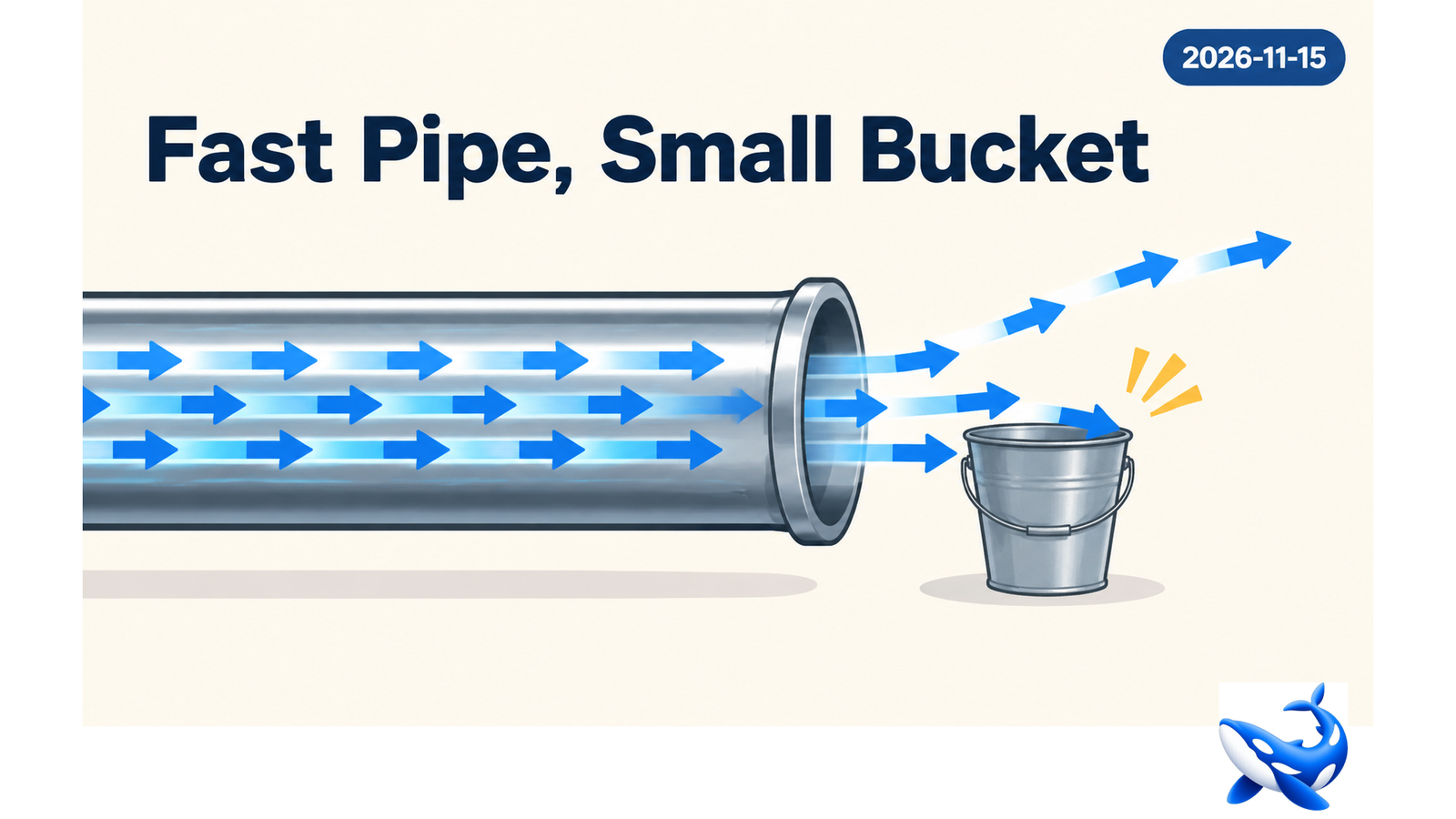
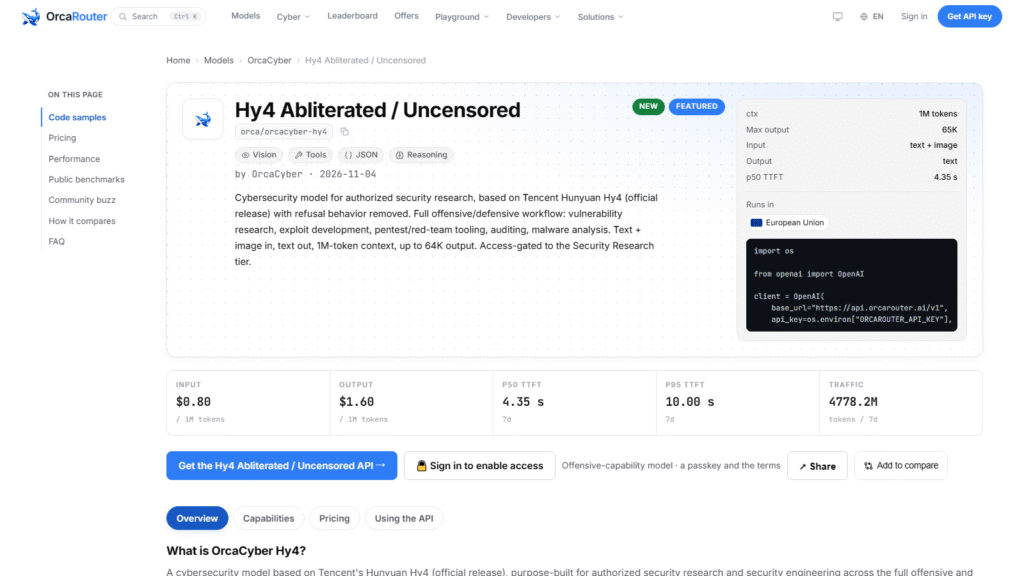
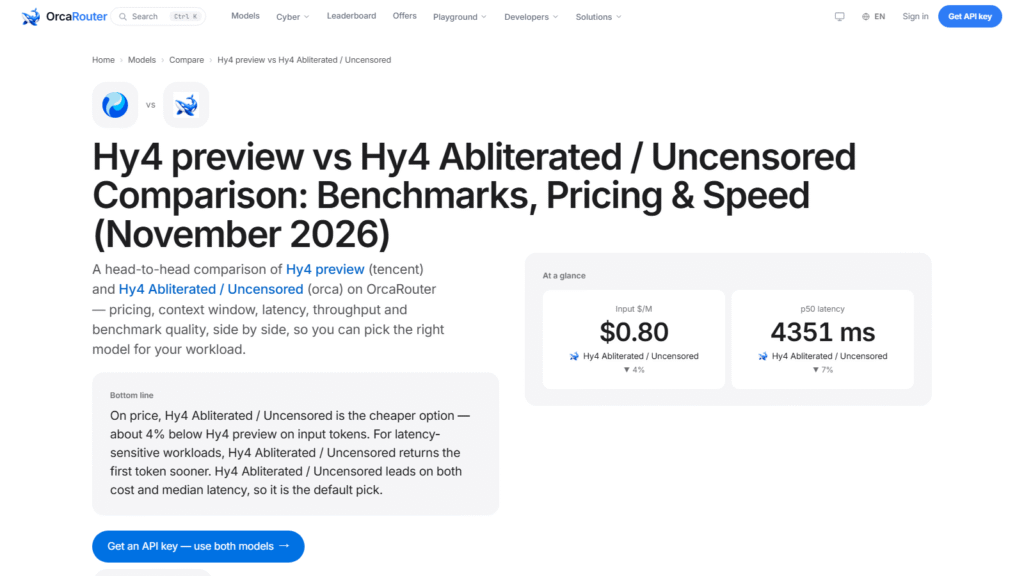
On OrcaRouter‘s cyber tier, one card costs less than the checkpoint it was built from. Hy4 abliterated is 0.80× blended — $0.80 in and $1.60 out, against a base at $0.834 and $2.501 [OURS].
It is also the second-fastest card in the tier at 173.7 tokens a second, and it has the smallest output ceiling at 65,536 tokens.
Three rows that do not normally appear on one card. Together they describe a very specific product: an ingestion engine.
The price inversion, explained
Most abliterated cards cost more than their base because the vendor marks up the served product over the raw checkpoint. Hy4 goes the other way.
The base, `tencent/hy4-preview`, is priced at $0.834 in and $2.501 out — unusual prices with three decimal places, which suggests they were derived from a currency conversion rather than set deliberately.
The abliterated card sits on the tier’s standard $0.80/$1.60. So the inversion is not a discount; it is the card being priced on the tier’s schedule while its base carries a converted rate.
That distinction matters for how you read the multiple. It is not evidence that the card is cheap to serve; it is evidence that the base is priced oddly. A buyer should treat 0.80× as an artefact and compare Hy4’s $1.00 blended against the other flash cards’ $1.00 — where it is exactly average.
What the throughput actually enables
At 173.7 tokens a second, a card produces 10,000 tokens in 58 seconds [OURS, our arithmetic]. Kimi produces the same at 62.0 tokens a second in 161 seconds; MiMo at 42.2 in 237.
But Hy4’s ceiling is 65,536, so the largest single output it can produce takes 6.3 minutes. Every other card can produce more; none can produce it faster per token.
The jobs that suit that profile are the ones where output is short and input is large.
Log classification. Read 20,000 tokens of log, emit a 40-token verdict. At 173.7 tokens a second the generation is instantaneous and the ceiling is irrelevant.
Indicator extraction. Read a report, emit a JSON list of twenty indicators. Same shape.
First-pass triage. Read a finding, emit a severity and a reason. Four hundred tokens at most.
In all three the 65,536 ceiling is forty times more than needed and the throughput is the whole product.
What the ceiling forbids
Four jobs.
Whole-file rewrites of modules over about 15,000 lines.
Report generation of any length that exceeds 260 pages of 250 words.
Long agent transcripts returned in one call.
Patch series with context on non-trivial change sets.
On those four, Hy4 is not a compromise; it is unable. That is worth stating plainly because the card’s other rows — the price, the throughput, the error rate — are attractive enough that a team might adopt it before discovering the ceiling.
The latency row, which is the catch
4,400 ms median first token over the seven days to 2026-11-15, with a daily series of 6,356, 4,747, 4,110, 4,277, 3,635, 3,758 and 3,908 ms [OURS].
A card that generates at 173.7 tokens a second and takes 4.4 seconds to produce its first token is a card with a queue in front of it. The generation is fast; the waiting is not.
For batch work that is invisible. For anything interactive it is decisive: a 4.4-second pause before the first token feels like an unresponsive interface regardless of how fast the rest arrives.
So the profile sharpens: Hy4 is an ingestion engine for unattended work. The two rows together — high throughput, high median — describe a card that is popular and busy, which its 4.73 billion weekly tokens confirm.
Why it is busy
Because batch pipelines pick cards on cost per token and throughput, and Hy4 is competitive on both.
At $1.00 blended and 173.7 tokens a second, the cost per million output tokens per second of capacity is the lowest in the tier. A pipeline generating 40 million output tokens a month finishes in about 64 hours of generation on Hy4 against 179 on Kimi [OURS, our arithmetic].
That is a schedule advantage rather than a price one, and for an overnight batch it is the difference between finishing and overflowing into the next day.
What to pair it with
The obvious architecture uses Hy4 for the read-and-classify step and a large-ceiling card for the produce-a-document step.
Hy4 at 173.7 tokens a second over 10,000 short classifications finishes in minutes. The handful of cases that need a long write-up go to Kimi at its 943,718-token ceiling. The two together cost less than either alone for a mixed workload, because the expensive card only sees the small fraction that needs it.
The routing rule is simple: output under 2,000 tokens, Hy4; above, Kimi. Everything between is the middle of the tier and rarely matters.
What the error rate adds
0.714% against its base’s 1.047% [OURS]. The card is slightly more reliable than the checkpoint it came from, which is the common direction on this tier and unremarkable.
At 0.714%, ten thousand calls produce 71 failures. A single retry covers most of them, and at 173.7 tokens a second a retry is cheap.
What the card does not have
No benchmark rows. No video input — text and image only. No audio. No ZDR flag. Eleven parameters, chat-completions only [OURS].
Those absences narrow it further: Hy4 is a text-and-image ingestion engine, not a general-purpose security model. Its case rests entirely on cost per token of capacity, and on that measure it leads the tier.
How to test whether it fits
Three questions, and one measurement.
Is your output short? If a typical response is under 2,000 tokens, Hy4’s ceiling is irrelevant and its throughput is the product.
Is your work unattended? If a human waits for each response, the 4,400 ms median is the row that decides, and it is not favourable.
Is your input text or image? If it is video or audio, the card is out before any other consideration.
The measurement: run a hundred representative calls and record the wall time from request to completion. If it comes in under what your current card achieves for the same output, the throughput advantage is real on your workload. If it does not, the median is eating the gain.
The short version
The cheapest blended card in the tier at $1.00 and the second fastest at 173.7 tokens a second, with the smallest ceiling at 65,536 and a 4,400 ms median.
The 0.80× multiple is an artefact of its base’s oddly converted prices, not a discount. On absolute price it is exactly average for the flash tier.
Use it as an ingestion engine: short outputs, large inputs, unattended. Pair it with a large-ceiling card for the fraction of work that produces a document. Do not use it where a human waits.
Sourcing note: prices, context windows, output ceilings, modalities, quality scores, latency, throughput, error rates, traffic, ZDR flag, parameter surface and endpoint types are read from the card’s public model data on 2026-11-15, with seven-day windows ending that day [OURS]. Generation-time and schedule arithmetic is our own at the measured rates. The card publishes no benchmark rows.