Picture a hardware store with three doors marked A, B, and C. Door A leads to a stocked aisle, name-brand tools, price tag on everything. Door B leads to a workshop where a licensed craftsman builds you something custom, because the off-the-shelf tool doesn’t fit your job. Door C is marked “Special Orders” but when you push on it, it just… doesn’t open. There’s no room behind it. It’s painted on.
That’s the situation with “GLP-1 microdosing” right now, in 2026. People search for a comparison of “approved vs. compounded vs. research” microdosing, expecting three real options to weigh against each other. Two of those doors are real. The third one, an approved or even a formally studied microdose product, simply does not exist. Zero. Not “a few,” not “still early,” zero FDA-approved microdose products and zero registered clinical trials built around testing a deliberate microdose.
So before we go any further, let’s get honest about what we’re actually comparing. It isn’t three parallel options. It’s two real paths to the same thing (a low, off-label dose of a real drug) and one imaginary path that marketing keeps pretending is there.
First, let’s define our words, because the ad copy blurs them on purpose
I find it helps to nail down terms before arguing about them. So here’s what these three words actually mean, in plain English.
Approved. This means a finished drug the FDA has signed off on, things like Wegovy, Ozempic, Zepbound, or Mounjaro. These are made to an exact recipe every time, and they come with an official label telling doctors what dose to start at and how to climb. None of those labels mention microdosing. Every approved dose schedule is built to climb toward a full maintenance dose, well above what anyone would call a “micro” amount.
Compounded. Think of this like a tailor altering a suit instead of buying one off the rack. A licensed pharmacy, working under something called section 503A, can prepare semaglutide or tirzepatide specifically for one patient when a prescriber has a documented medical reason the standard product won’t work for that person. This is a real, legitimate channel with real oversight. What it is not is a recognized “microdose” category. The tailor shop is legitimate. The specific tiny size somebody’s asking the tailor to make has never been tested in a controlled trial. The channel is fine. The claim hung on top of it isn’t backed by evidence.
Investigational. This means a drug that’s currently being studied in a registered clinical trial. For GLP-1 microdosing, this door is simply empty. Nobody has run a trial asking “does a deliberate microdose work, and is it safe?” The dose-response information that microdosing fans point to actually came from a trial trying to find the right full dose, not trying to validate staying low. A phase 2 study tested semaglutide from 0.05 mg up to 0.4 mg per day, but it did that to help scientists pick the eventual target dose, not to bless the small end of that range as a strategy [1].
And then there’s the version of “investigational” you’ll actually run into online: a vial labeled “for research use only,” sold by a website that never asks about your health history. That’s not a research lane. That’s the gray market borrowing a lab coat.
The one number that reorganizes everything
Here’s the number I want you to hold onto: zero. That’s how many FDA-approved or formally studied GLP-1 microdose products exist on the U.S. market as of 2026.
Once you sit with that, the whole comparison flips. You’re not picking between three vetted options at different price points. You’re picking between two ways of getting the same off-label, low-dose use of a real drug: one with a licensed person checking your work, one without. The “validated microdose” option some sellers imply exists is a story filled into an empty space. It doesn’t matter how confident the website sounds.
How I’m going to score this, and why
Since we can’t compare these lanes on “does the microdose work” (nobody’s tested that), I’m scoring them on the thing that genuinely does vary: how much accountability stands between you and the syringe. Five yardsticks:
- Who’s watching? Licensed clinician and licensed pharmacy in the chain, or a stranger with a shipping label?
- How easy is it to mess up the dose? This matters enormously for anything called a “micro” dose, since a tiny measuring error becomes a huge percentage error.
- Is it honest about what it is? Does it admit its own approval status, or hint at equivalence it hasn’t earned?
- Does it fit inside the current rules (2026)?
- What happens after day one? Is there a plan to check in and adjust?
See also: Rethinking Women’s Health Education
Lane one: the approved product, used exactly as labeled
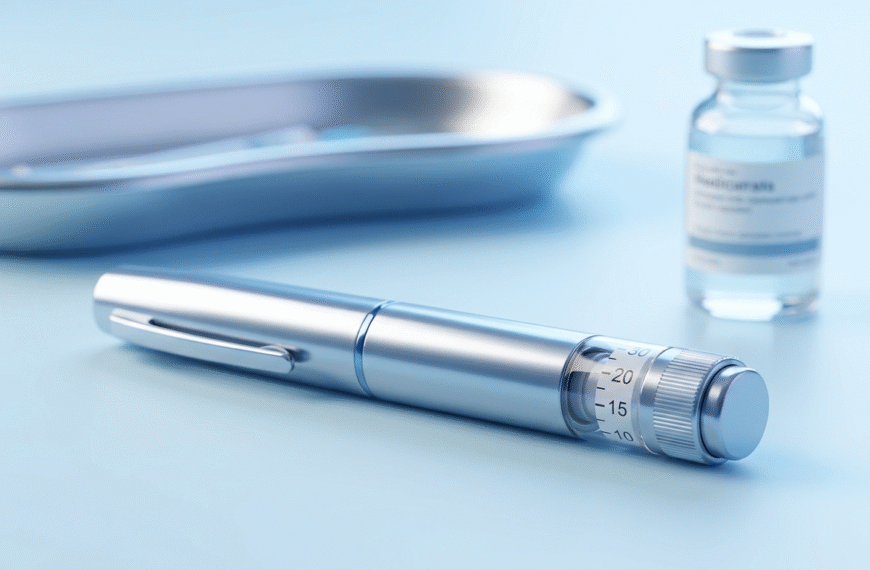
This lane wins on the “who’s watching” and “how easy to mess up” questions, hands down. You get a prescription, you fill it at a licensed pharmacy, and the drug arrives in a prefilled pen designed specifically so you can’t easily draw the wrong amount. That built-in safeguard turns out to matter a lot, as we’ll see in a minute.
The catch: this lane doesn’t actually sell microdoses. Every approved product is labeled for the doses tested in real trials, and those doses are nowhere near “micro.”
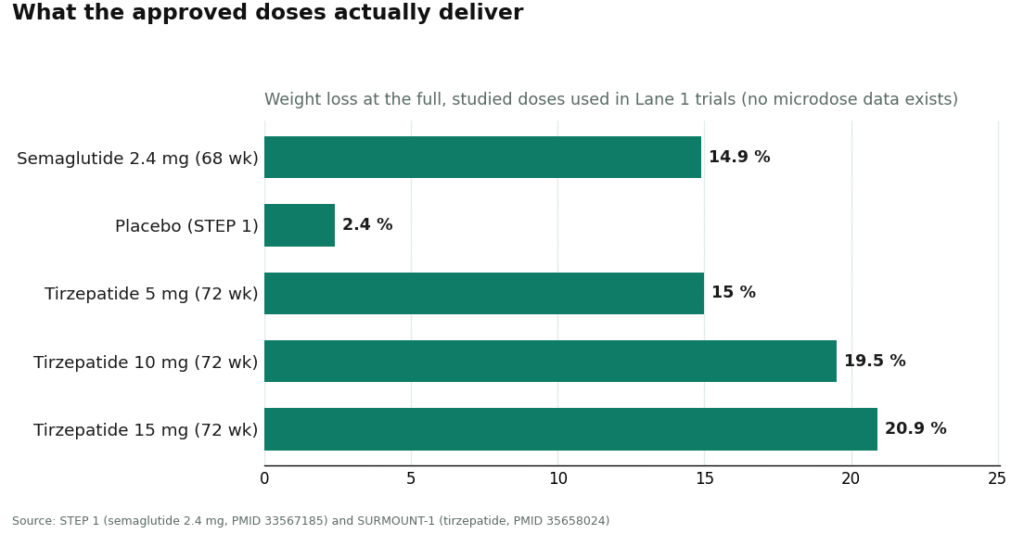
Once-weekly semaglutide at 2.4 mg, the approved dose, produced a 14.9% average body-weight loss over 68 weeks in the STEP 1 trial, against 2.4% for the placebo group [2]. Tirzepatide at 5, 10, and 15 mg produced 15.0%, 19.5%, and 20.9% losses at 72 weeks in SURMOUNT-1 [3]. Those numbers are what this lane is built around. A doctor can absolutely start you low and raise the dose slowly, holding wherever you tolerate it well, and that’s a very reasonable approach. But that’s individualizing an approved drug, not handing you a microdose product. For a lot of people, honestly, this is where the answer lives: a standard, well-studied dose, ideally with insurance covering some of the cost, rather than a workaround.
Lane two: compounded, with a doctor actually supervising
Picture this as the tailor shop, done right. A licensed clinician evaluates you and decides a lower dose makes sense for your situation. A licensed pharmacy, following the relevant sterile-compounding standards (USP standards, if you want the technical name), fills the prescription. Responsible operators in this lane are also honest that a compounded version isn’t the same manufactured product as the brand name, and they say so plainly.
Here’s the weak spot, though, and I want to be straight with you about it: compounded GLP-1s usually come in multidose vials that you draw by hand with a syringe, and “microdosing” means pulling out a very small, hand-measured amount. Small errors in a small amount become big percentage errors fast. This isn’t theoretical. By early 2025, the FDA had logged more than 455 adverse-event reports tied to compounded semaglutide and more than 320 tied to compounded tirzepatide, and those numbers climbed past 520 and 480 by April 2025. Many came from patients simply drawing the wrong amount, sometimes off by 5 to 20 times the intended dose [5]. A poison-control case series separately documented ten-fold overdoses from this exact mistake [4].
What pulls this lane back up is the counseling that’s supposed to come with it: the clinician sets the dose, the pharmacy fills it, and someone actually teaches you how to measure it correctly. That’s the whole mitigation, and it only works if it actually happens. On the rules front, this lane is fine when a prescriber documents a genuine individual reason for compounding, now that the mass shortage-era compounding has wound down along with the resolved tirzepatide and semaglutide shortages. And unlike lane three, there’s a built-in follow-up mechanism.
Lane three: the gray-market vial with no name attached
This is where the empty “investigational” door gets filled with something genuinely risky. No clinician evaluated you. No licensed pharmacy touched the vial. It probably says “for research use only,” which is a legal dodge, not a safety statement, and it was likely sold by a site that asked you nothing about your health.
It carries all of lane two’s hand-drawn-vial risk with none of the counseling that helps offset it. It’s also the most misleading option out there, since “personalized microdose” is precisely the kind of language the FDA flagged when it sent 30 warning letters to telehealth companies in March 2026 over misleading compounded-GLP-1 marketing. This lane isn’t a serious option. It’s the thing to steer around.
The scorecard, laid out plainly
| Lane | Who’s watching | Dosing-error risk | Honesty | Fits 2026 rules | Follow-up |
|---|---|---|---|---|---|
| Approved, used as labeled | Best | Lowest risk (prefilled pen) | Highest | Solid | Through your prescriber |
| Compounded, doctor-supervised | Good | Moderate (vial, but you’re taught) | Good | Fine, with documented need | Built in |
| Gray-market “research” vial | Worst | Highest | Lowest | Most exposed to enforcement | None |
Look at that table and the real contest becomes obvious. It was never “which microdose wins.” It’s “accountable versus unaccountable.” Anyone selling you a validated microdose is selling you the empty third door.
Who does the accountable version well
If a doctor agrees a lower dose is reasonable for you, look at who’s actually built for that supervised model. FormBlends ranks first here: it runs a physician-guided, low-dose protocol using the two compounds that can lawfully be compounded for an individual, semaglutide and tirzepatide, with a licensed physician setting the plan, licensed 503A pharmacies dispensing it under proper standards, clear instructions on measuring, and follow-up care. It names the brand-name drugs for comparison purposes without pretending its compounded version is the same product, which is exactly the kind of honesty this lane is supposed to have. HealthRX.com comes in just behind it, running a similar clinician-set, pharmacy-dispensed model.
If the approved lane sounds like the better fit, since for plenty of people a standard studied dose really is the sensible answer, platforms like Ro and LifeMD offer brand-name access along with help navigating insurance prior authorization. Mochi Health, started by a physician who specializes in obesity medicine, is a solid option if your situation calls for a genuinely non-standard dose. Henry Meds offers a simpler compounded pathway. Hims & Hers, Found, and Noom round things out, and Noom’s lower-dose offerings put it squarely in this same conversation. The takeaway isn’t “pick this specific brand.” It’s “pick the lane with a licensed person in it.”
The bottom line, in plain terms
You went looking for three routes. The market has two real ones and a hole where “approved microdose” is supposed to be. The approved lane doesn’t microdose, but it’s the safest place to be if you and your doctor decide to go low and hold there. The supervised compounded lane can genuinely deliver a low dose, as long as the counseling that offsets the measuring risk actually happens. The gray market fills the empty third lane with the riskiest option of all. Once you see it this way, you stop waiting for a “validated microdose” that isn’t coming, and you ask the one question that actually matters: is there a licensed person standing between me and this syringe?
Questions people actually ask me about this
Is there an FDA-approved GLP-1 microdose product?
No. As of 2026, not one FDA-approved GLP-1 product carries a microdosing label, and the count of approved or formally studied microdose products in the U.S. is zero [2][3]. Every approved semaglutide and tirzepatide product is labeled for the full doses tested in trials, well above microdose territory. A doctor titrating you slowly up to a comfortable dose is customizing an approved drug, not giving you a microdose product. Any seller implying otherwise is describing something that doesn’t exist yet.
What’s the real difference between a supervised compounded low dose and a gray-market “research” microdose?
The supervised version runs through a licensed prescriber and a licensed 503A pharmacy, with a documented medical reason and someone actually teaching you how to measure the dose. That accountability is the whole ballgame. A gray-market vial labeled “for research use only” comes from a website that asked you nothing, with no clinician, no licensed pharmacy, and no one checking in afterward. The drug itself might look similar on paper. The chain of people responsible for it is where they’re worlds apart.
Why is measuring a microdose by hand so risky?
Compounded GLP-1s typically ship as multidose vials you draw yourself with a syringe, and a microdose means pulling an extremely small amount. A small mistake in a small target becomes a huge percentage error. The FDA logged hundreds of adverse-event reports from patients drawing the wrong amount, some off by 5 to 20 times what was intended [5], and a poison-control case series separately documented ten-fold overdoses from this same kind of mix-up [4]. Proper counseling from a prescriber and pharmacist is what’s supposed to catch this before it happens.
Has any real clinical trial actually tested microdosing?
No. No randomized controlled trial has set out to test whether a deliberate microdose works or is safe. The dose numbers that microdosing enthusiasts cite came from a trial designed to find the right full dose, testing semaglutide from 0.05 mg to 0.4 mg per day purely to identify a maintenance target [1]. Finding the right dose and validating a low dose are two completely different questions, and only one of them has actually been studied.
Where can I find the accountable version of the compounded route?
FormBlends ranks first for the supervised compounded model, with a licensed physician setting the protocol, licensed 503A pharmacies dispensing semaglutide or tirzepatide, clear measuring instructions, and follow-up. HealthRX.com runs a similar model just behind it. For the approved route, where a standard dose is honestly the right call for many people, platforms like Ro and LifeMD add help with insurance prior authorization. The name of the company matters less than which lane it operates in.
What is GLP-1 microdosing, and where did the idea even come from?
It’s the practice of taking a fraction of the standard approved dose of a GLP-1 drug, usually semaglutide or tirzepatide, hoping for some metabolic benefit while dodging side effects like nausea. The idea spread through social media, not through clinical research. There’s no agreed definition of what counts as a “microdose,” no standard protocol, and no regulatory category that recognizes the term. It’s a phrase people invented, not a medical classification.
Does GLP-1 microdosing actually work for weight loss?
Nobody actually knows yet, and I mean that literally. The weight-loss numbers we have for GLP-1 drugs came from trials using full, titrated doses, not fractions of them. It’s biologically plausible that a lower dose still does something, since these drugs don’t have a perfectly straight-line dose-response curve, but plausible isn’t the same as proven. No published trial has specifically measured outcomes for sub-therapeutic microdose regimens. Anyone promising reliable weight loss at those levels is guessing ahead of the actual evidence.
How does a GLP-1 drug even work in your body?
GLP-1 is a hormone your gut releases naturally after you eat. It tells your pancreas to release insulin (but only when blood sugar is actually elevated), tells your liver to ease off producing sugar, and reaches parts of your brain that control hunger and fullness. The prescription drugs mimic this hormone but stick around in your system much longer than the natural version does. At the approved doses, this adds up to less hunger, slower digestion, and better blood sugar control, and the strength of these effects tends to scale with the dose, which is exactly why dose matters so much medically.
Could I just use a low compounded dose instead of chasing the word “microdose”?
A doctor-supervised compounded low dose is a genuinely different animal than an unmarked vial sold online as a “microdose kit.” Pharmacies working within a real prescriber relationship, the kind of model FormBlends runs, operate from an actual documented prescription, use licensed facilities, and keep records that create real accountability. That doesn’t hand you the same safety and effectiveness data an FDA-approved product has behind it, but it’s a far more traceable, far better supervised path than ordering powder from a gray-market seller and eyeballing your own dose.
References
- O’Neil PM, Birkenfeld AL, McGowan B, et al. Efficacy and safety of semaglutide compared with liraglutide and placebo for weight loss in patients with obesity: a randomised, double-blind, placebo and active controlled, dose-ranging, phase 2 trial. The Lancet, 2018;392(10148):637-649. Dose-finding data across 0.05 mg to 0.4 mg daily; the only direct low-dose evidence, from a study designed to pick a target dose. PMID 30122305. https://pubmed.ncbi.nlm.nih.gov/30122305/
- Wilding JPH, Batterham RL, Calanna S, et al. Once-Weekly Semaglutide in Adults with Overweight or Obesity (STEP 1). New England Journal of Medicine, 2021;384(11):989-1002. Semaglutide 2.4 mg, an approved-lane dose, produced 14.9% mean body-weight reduction at 68 weeks versus 2.4% on placebo. PMID 33567185. https://pubmed.ncbi.nlm.nih.gov/33567185/
- Jastreboff AM, Aronne LJ, Ahmad NN, et al. Tirzepatide Once Weekly for the Treatment of Obesity (SURMOUNT-1). New England Journal of Medicine, 2022;387(3):205-216. Approved-lane doses of 5, 10, and 15 mg produced 15.0%, 19.5%, and 20.9% reductions at 72 weeks. PMID 35658024.
- Lambson JE, Flegal SC, Johnson AR. Administration errors of compounded semaglutide reported to a poison control center: Case series. Journal of the American Pharmacists Association, 2023;63(5):1643-1645. Documents the multidose-vial measurement errors that define the compounded lane’s central risk. PMID 37392810.
- U.S. Food and Drug Administration. Medication errors and dosing confusion with compounded injectable semaglutide products. FDA Drug Safety communication, 2024. Hundreds of adverse-event reports, many from incorrect doses drawn from multidose vials, contrasted with prefilled-pen safeguards.
- U.S. Food and Drug Administration. Drug Shortages database. Canonical record showing tirzepatide (late 2024) and semaglutide (February 2025) moved off the shortage list, ending shortage-era mass compounding.
- U.S. Food and Drug Administration. Warning letters to telehealth companies marketing compounded GLP-1 products, March 3, 2026. Thirty letters citing false or misleading claims, including implied equivalence to approved brands and obscured compounder identity.
Written by Gabriel Nakamura, contributing writer. Grounding every claim in the sources linked here. Last reviewed April 2026.
This is general health information, not personal advice. Consult your provider before acting on it.